Quadratic Reciprocity and the Theta Function
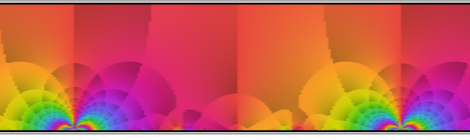
One of the better-known proofs of quadratic reciprocity involves the Gauss sums. This post gives a variant proof which motivates the introduction of Gauss sums using the Jacobi theta function.

One of the better-known proofs of quadratic reciprocity involves the Gauss sums. This post gives a variant proof which motivates the introduction of Gauss sums using the Jacobi theta function.
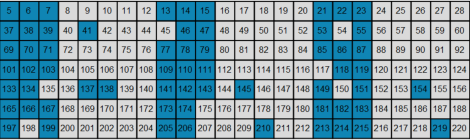
Euler gave a proof of the infinitude of primes which used the meromorphic behavior of the Riemann zeta function. In this post, we show that similar ideas can be used to show the infinitude of congruent numbers.

While discussing the history of the modern factoring, Carl Pomerance’s 1996 expository piece “A Tale of Two Sieves” describes a factoring algorithm called Kraitchik’s Method and demonstrates the algorithm by factoring 2041.
The example is nice; certainly nicer and more illustrative than what you might produce at random. But exactly how special is Pomerance’s 2041 example?

Stirling’s approximation gives a useful estimate for large factorials. This post contains a (new?) proof of Stirling’s formula which relies on properties of the Riemann zeta function.
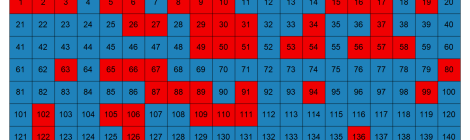
If a set of positive integers contains no arithmetic progressions, how large can it be? In this post, we study this question in the context of harmonic sums.

Most factorization algorithms in use today fit in one of two camps: sieve-based methods based on congruences of squares, and algorithms based on decompositions of algebraic groups. In this article, we trace the common thread connecting the latter.
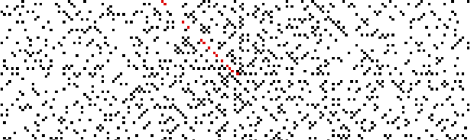
One of Landau’s four problems from 1912 concerns the infinitude of primes in the values of a certain quadratic polynomial.
In this post, we show that the largest prime factors of the values of this polynomial are “relatively large” infinitely often.
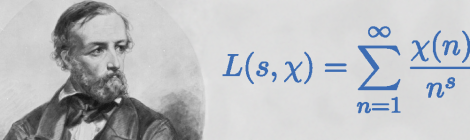
Dirichlet’s Theorem on the infinitude of primes in arithmetic progressions relies on the non-vanishing of non-trivial Dirichlet characters at 1.
In this post, I’ll show how this reduction can be introduced in an intuitive way via sieve theory. If we actually sieve, we obtain estimates for the number of integers whose prime factors lie in given congruence classes.
Which integers are a multiple of the sum of their “small” divisors? In the post, we study whether this set should be finite or not.
Our partial solution relates this problem to many outstanding conjectures in number theory about the distribution of prime numbers, such as the twin prime conjecture and the infinitude of Mersenne primes.

In this note, I’ll discuss why square-root cancellation is so typical in problems in number theory and give a quick survey of important sums known or widely conjectured to satisfy bounds of this form.

