Quadratic Reciprocity and the Theta Function
One of the better-known proofs of quadratic reciprocity involves the Gauss sums. This post gives a variant proof which motivates the introduction of Gauss sums using the Jacobi theta function.

One of the better-known proofs of quadratic reciprocity involves the Gauss sums. This post gives a variant proof which motivates the introduction of Gauss sums using the Jacobi theta function.
Euler gave a proof of the infinitude of primes which used the meromorphic behavior of the Riemann zeta function. In this post, we show that similar ideas can be used to show the infinitude of congruent numbers.

Stirling’s approximation gives a useful estimate for large factorials. This post contains a (new?) proof of Stirling’s formula which relies on properties of the Riemann zeta function.
One of Landau’s four problems from 1912 concerns the infinitude of primes in the values of a certain quadratic polynomial.
In this post, we show that the largest prime factors of the values of this polynomial are “relatively large” infinitely often.
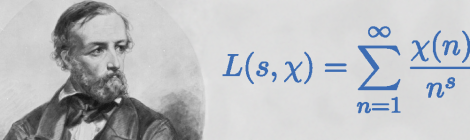
Dirichlet’s Theorem on the infinitude of primes in arithmetic progressions relies on the non-vanishing of non-trivial Dirichlet characters at 1.
In this post, I’ll show how this reduction can be introduced in an intuitive way via sieve theory. If we actually sieve, we obtain estimates for the number of integers whose prime factors lie in given congruence classes.
Which integers are a multiple of the sum of their “small” divisors? In the post, we study whether this set should be finite or not.
Our partial solution relates this problem to many outstanding conjectures in number theory about the distribution of prime numbers, such as the twin prime conjecture and the infinitude of Mersenne primes.

In this note, I’ll discuss why square-root cancellation is so typical in problems in number theory and give a quick survey of important sums known or widely conjectured to satisfy bounds of this form.

This post discusses two classic problems in analytic number theory: the Gauss circle problem and the Dirichlet divisor problem.
These problems are known to be related at a deep level, a fact which is often missed at first glance because the obvious/early attacks on them look quite different.
In this post, I compare these “trivial” estimates, and show how Gauss’ estimate can be realized using a few different techniques.

One of the ingredients in a paper that Bram Petri and I submitted in 2016 was a count of integer matrices of determinant 1 with non-negative entries and bounded trace.
Our paper only required an upper bound, but as a number theorist I couldn’t resist the temptation of describing the asymptotics of this function more precisely. In this post we explore do just that, exploring Dirchlet’s hyperbola method along the way.

The Gauss Circle Problem is a classic open problem in number theory concerning the number of lattice points contained in a large circle.
Optimal error bounds are known in these approximations in a generalization of the Gauss Circle Problem to spheres in dimensions four and above.
In this post, I’ll give a purely analytic proof of this result for even dimensions greater than four, and explain why the method fails in the other cases.
 a. w. walker